Showing posts with label Monster Reviews. Show all posts

Wednesday, 2 January 2019

Monster Review - Boggle [Volo's Guide to Monsters, 128]

The Boggle is a strange baddy that I'm choosing to review because I've had to contend with this last few weeks ever since my players rescued one and it became a party mascot-come-cohort and obstinately refuses to die. I've even begun levelling him up and granting him more powers as the players support him in learning more magic than his natural oil tricks.

The Boggle derives from one of those grubby little Fey that spends its time being blamed for many minor ills by superstitious peasants. These seem to exist in every culture where you may need to explain why milk goes bad or why sometimes crops die in a world without the Scientific Method. My theory is they're a counter to children relentlessly asking 'why' when you're just trying to live to the ripe old age of 30 in crushing rural poverty - because The Boggle does it, and if you don't shut up he'll Boggle you too.

Let's look into the Feywild's answer to Exxon Valdez....


Art
I find this one baffling, but nothing can compare to the sheer misbegotten weirdness of the 1983 depiction. The artist has put some effort in to modernise the monster, I feel: the innate silliness of Fey creatures with pants made of leaves or little lederhosen rather detracts from their value as a scary force, and I'm a great believer in scary Fey. Its a creepy design but parts of it seem incongruous to the description - why is this cheeky little trickster sat on a mound of humanoid skulls? The teddy bear and skulls make for a sort of jarring quality to the creature which works well for me: as though the little Boggle sees no distinction between prank A (stealing your teddy bear) and prank B (throwing your baby in a river), and I like the idea that the little bastards just don't understand a world of consequences. The creature itself is a sort of Disneyfied Goblin: all big heads and hands to give it a cutesy sense. And yet, the empty yellow eyes seem emotionless and predatory and cunning. It tries to walk the difficult line of creepy-yet-cute and is only somewhat successful.

Purpose and Tactics
Look at the size of that stat-block. Just look at it. It is as large as an Alhoon (A twelfth-level spell caster psychic vampire nasty) yet it describes a CR 1/8 lightweight with two silly gimmicks. The sheer density of this statblock's text is enough reason to give up on the Boggle immediately, especially as this is not a boss-monster - it's a CR 1/8 seasoning on top of an existing encounter. Even the fluff basically tells you to use this guy as an extra helping of spice on top of an existing baddie. On it's own, even a gang of Boggles (What's their collective noun? I like "an anarchy of Boggles..") is going to be a mildly annoying road-block for most parties.


In a scrap, the Boggle has two low-impact gimmicks which apparently take most of the word count of War and Peace to explain: it makes oil in sticky or slippery varieties and it has a kind of localised portal-making ability. As a trickster supporting big bads, these can be quite fun: creating oil puddles to block parts of the terrain or to stickily grapple spellcasters - it can even reach through its dimensional rift to steal from players or stop them using door or other portals. These are fun trickster abilities, but two caveats remain. Firstly you definitely need to plan around these abilities to make them useful as they are situational. Maybe there's some kind of maguffin the players are trying to capture and the Boggle has nabbed it and is escaping whilst heavier brutes battle the players. Maybe there is a labyrinth of narrow corridors, many doors and many areas where climbing would be essential: here a Boggle would excel, moving around quickly and leaving nasty oil splotches to disrupt action economy. Examples allies for a Boggle could be big, brutish fairy-tale creatures like Ogres, or a Fey Warlock and his heavies. I'd avoid having too many Fey creatures that also have fiddly powers and spell-like abilities unless you want to spend the entire combat looking at your monster books and scratching your head.
Secondly, you need to be away of the very stringent limitations of these abilities. A huge amount of this is filler abilities. Your Boggle might get advantage of grapple, but that requires sitting in melee range and it has a negative to strength. The Oil Puddle can only be in the Boggles' space. it's damage output is perfunctory and really a last-ditch option after its allies are dead.

For its CR, a Boggle can actually take quite a pounding with its resistances, defences and mobility, but I suggest still avoiding damage and staying out of combat as much as possible and seeing that as your life-line against potential missteps.

From a story perspective, the Boggle is a good cohort monster for fey-linked baddies especially as it has a tendency towards chaos that the characters could use to work with it diplomatically. It would also work well in adventures for children where you might want to minimise threat and violence - using its Dimensional Rift to pull the character's pants down to make them fall over - a sort of grubby Macaulay Culkin.


Fluff
Criminally, a considerable portion of this fluff just reiterates parts of the splat-block, telling us that Boggles use oil and can teleport.  It has a great folkloric origin story in that a Boggle can be created by a child's loneliness, and the fact that they are unreliable allies prone to changing sides (in my canon, purely out of a sense of anarchic glee). Other than that, this is fairly standard material giving examples of tricks and pranks a Boggle might perpetrate - most of which are great plot-hooks for low-level characters, and they open up the Boggle as a potential puzzle monster. Unlike many of the puzzle monster fraternity (Werewolves, Ghosts etc) the Boggle will go down in 2 or 3 hits so there won't be much of a scrap.

Plot Hooks
Grumkin and Grud's Orphanage for Wayward and Criminal Children is bedevilled, and they have looked for an exorcist to cleanse their Orphanage: surely the children are possessed by some fiend, as milk sours, keys go missing, plates are smashed, and none of the guardians have caught the children doing it.

Otterridge and Son's Mining Consortium are looking for stalwart adventurers to put the miners back to work in the Ferrotang Iron Mine. The workers complain of creatures in the dark, tools being stolen away and portals to other dimensions. They are sure some horrifying evil has been disturbed and have go on strike. Remind these entitled shirkers of their obligation to Otterridge.

The Merchants-Guild of Hulderborg are vexed by some new master-thief that they call The Greedy Ghost - he has slipped into every major bank-vault and private store they possess without incident, but steals only minutiae: pens and keys and papers and underwear. Everything else, he subverts He has painted a moustache on the priceless painting Princess Reclining With Pear  and knocked the arms off  the Terracotta Gladiators of Xin-Jiang. Bring this detestable anarchist to justice.

Verdict: A fun and unique puzzle-monster and servant-monster hamstrung by an absurd over-writing of its powers.



Monday, 17 September 2018

Monster Review - The Marid [Monster Manual, 146]

The Marid is a strange fish. It is one of several elementals who derive from Arabic culture and language, yet is has almost nothing in common with the mythological progenitor: a marid is simply a rebellious jinn and jinns have nothing to do with water.

I much prefer them to the other kinds of elemental, as they have far more character than 'a big living wave' and feel more like living things. Let's make waves...


Art
I have mixed feelings on this piece. The face is amazingly characterful and the face slightly looking over the shoulder just screams low cunning - I can imagine being ripped off by this corpulent cod-man. It manages the rare feat of having personality and character yet looking totally alien. There are some good little characterful designs in the clothing which are the kind of tiny hooks which can make a race memorable to players: are those big shoulders an example of Marid power-dressing? What's that fish on his belt for? I think a key inspiration here is the Vodyanoi of the Bas-Lag universe, which I can always get behind.

However, I hate the 'below the waist I am water/air/fire/some rocks' conceit in elemental design, and here is looks bizarre and amateurish. Because the Marid is a chubby fellow it looks even more incongruous. There's also the lack of thought - why does this creature wear obviously not waterproof clothing made from cloth? Wouldn't everything in that bag get soaked in water? Why is he wearing a belt when he doesn't have legs, never mind trousers? The fluff even claims they wear pantaloons...

Purpose and Tactics

The Marid, being an intelligent and powerful Chaotic Neutral creature, could easily be a quest-giver, patron, rival or contact of the player-characters, especially in an aquatic or maritime campaign. I'd love to run one as a rival to a party, swimming around on some half-sunk barge with slaves in tow.

Should you use one as an antagonist, they are not the most interesting battlers, working best as a boss supporting a group of damaging melee combatants like Sauhagin, Kuo-Toa, Chuul, Sharks or Merfolk. The most interesting mise-en-scene for such a battle would be a rocky coastline, island chain, coral reef, shipwreck, cliff-face or other place where there is an interplay of air, water and land, foregrounding the advantages and tactics of the Marid. His spells are fairly useless in an actual fight, and probably frustrating to player-characters if he is an antagonist: he can use Invisibility, Plane Shift or Gaseous Form to easily escape. He also carries a load of spells clearly intended to be helpful to a friendly party: Water-Walk, Water Breathing, Purify Food and Water, Tongues...The only spells that will see much use in a scrap are Conjure Elemental (note the one minute casting time though), Fog Cloud, Invisibility and Control Water. Aside from buffing sneaky minions with Invisibility or Fog Cloud, most actions spent on casting are a waste.

This reduces our Marid to a rather shallow pool of combat options. He has a Trident multiattack which deals reasonable if unimpressive damage - you should always use it two-handed in melee as the Marid has no shield and does not require an arcane focus etc for its innate spellcasting. The Water Jet is a pretty tidy supportive option, potentially pushing back foes and knocking them prone so your minions can smack them with advantage.


The Marid's other abilities revolve around being really, really time-consuming to kill. Ignoring the previously mentioned ability to just nope out of a combat with your players with Plane Shift or Gaseous Form, it also has a very fast swim and fly speed, a big pile of hit points and a few resistances to shore it up even more. I personally don't find battles of attrition all that fun, but a chase scene or combat where killing the Marid is not the direct goal could still be very fun - rescuing people from a sinking ship, hunting a great white whale or escaping a flood perhaps.

Fluff
The Marid gets a pretty big write-up for a Z-list monster which very few people will use and which can't be summoned with Conjure Elemental. Much of this info would make for a very memorable recurring NPC: they're egotistical and obsessed with self-aggrandising titles (never introduce a  Bob the Marid when you can introduce Sovereign of Saltwater, Sultan of the Seven Seas, Most Resplendent Emperor of Dew and Rain and Damp, Pearl of the Oceans, His Supreme Magnificence the Imperator Bob the Marid ...) They collect slaves but get a pass on being kicked down into chaotic evil because they're mostly just baubles - more of an entourage for this Z lister than someone who lowers themselves to work.  They also possess an almost bardic focus on stories, tales and legends: something which always makes an NPC interesting. I'd love to hear more of their coral fortresses, but I find its hard to tow the line between the tone of good underwater fantasy and silly My Little Mermaid-esque Disney underwater fantasy.

It's also full of rich tidbits for plot-hooks and adventure ideas: Marids politicking with wizards, Marids seeking out stories, Marids trapped in conch-shells, Marids kidnapping rock stars for their underwater courts....

Plot Hooks

Thuuloso the Ever-Wise, Countess of Crashing Tides can scarcely contain her rage. She shatters boat-hulls and throws up storms to lash at the shore in impotent fury. A cunning magi has stolen her beloved wife and secreted her in an old wine bottle to blackmail Thuuloso into obedience. She would like some mercenaries to walk their 'feet' over the dry lands to find this wine bottle and humble the braggart who would tear her from her soul-mate.

Sulis, Master of the Maberonian Sea, swans about on his great under-water flotilla across the sea, served by his chained mer-men and propelled by his prized hunting-sharks. Should it take his fancy he will drift underneath a mortal ship: some heavy-hulled merchant vessel groaning with amber, antler and fur, or some sharp blade-prowed warship with full complement of ballistae and and braggadocio - or even some low-decked fishing-sloop where a lone and aging man feeds his ever-growing family. From each Sulis will exact a tribute: a fine pearl, or strange delicacy from the land-dwellers (this small brown orb contains the heart of a great oak tree) or spun tale or joke or limerick or service - it matters not the tribute, for Sulis is as capricious as the sea itself.

Throughout the Gilded Sea there is an old legend about the island of Palette's End. Its jagged, romantic visage has inspired countless artists to greatness and yet....there are the disappearances. The losses. Some say artists, ever flighty and prone to melancholy, might have thrown themselves in the sea. Others whisper that the starving artists, penniless, fell victim to debt-collectors. Peasants gossip of the Witch of the Waves who plucks them like o'er-ripe fruit and drags them to her undersea court. But the fact remains - whenever the truly great stay to long on that strange, water-wracked coast, they disappear...

Verdict: A reasonably interesting creature concept let down by a stat-block which doesn't give much for the players to chew on in combat.


Sunday, 9 September 2018

Monster Review - The Merregon [Mordenkainen's Tome of Foes, 166]


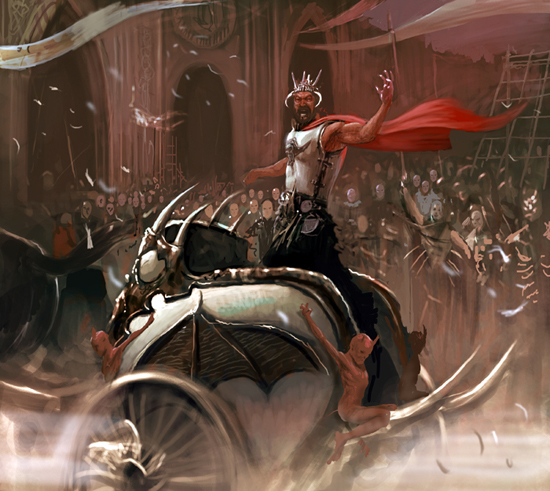
Image result for merregon art mordenkainenThe Merregon is one of a legion of new monsters introduced in Mordenkainen's to flesh out the hierarchy of Team Fiend. Based on an unthinking, automaton-like soldier, he is the G.I. of Avernus - the banal evil marching to Hell's drum.

These foot-soldiers of Old Scratch are fairly old themselves, having been in  Third Edition and Pathfinder supplements, and they really help bulk out the armies of Hell without having a CR budget that looks more like a phone number. Let's march on to the Merregon:


Art
I adore this piece. The strange, slightly-too-low facial mask is perfect uncanny valley fodder, and manages to be chilling whilst evoking the Merregon's focus on uniformity and discipline. There is a fear not just of being physically defeated but of being assimilated and dehumanised by a faceless mass. It even has a sort of beatific calm to the face - standing in gross juxtaposition to the violence which typifies a Merregon's existence.

The focus on armour makes the Merregon seem almost mechanical rather than organic, but there are clear burly arms holding aloft the halberd. The creature seems to even stand in a way that shows submission before another authority. This is a great example of art reflecting fluff, and the subtle horror of this image made me immediately want to throw some at my players.

Purpose and Tactics
The Merregon's is not to reason why, his is but to do and die. As plodding poor bloody infantry their singular purpose is to fight and die in the endless parade of carnage which is politics in Hell. When used in your campaign, they work brilliantly as cohorts and bodyguards of the big bads of Hell. If you're running a Chain Devil or Erinye other powerful 'leader' of Hell, they make excellent support characters. Not only do they gain an extra attack when within 60 feet of any CR 6 or stronger devils, they can stand between them and an opponent and take hits. Whilst a measly 45 HP is not going to last long against focused PC assault, having them die in the place of the big bad keeps the scarier Devils alive long enough to loose their terrifying abilities. Additionally, like most fiends they have a big pile of resistances, boosting their durability. An immunity to Fire make them great opponents to cluster around a group of PCs who are about to be hit by a Fireball or other Fire attack - the Merregons can pin them in place and prevent them moving (fearful of attacks of opportunity) whilst a fiery fusillade of hell-fire rains down.


In terms of positioning, they should crowd around an infernal dignitary, halberds out - they can unleash a weak barrage of crossbow bolts on PCs that maintain distance and use their reach to try and keep player-characters at bay. Like all Devils, they have the Devil's Sight ability, so if they're guarding a spellcaster he could cast a high-level magical Darkness on his Merregon underlings to make a moving phalanx of shadow and spikes - a tough nut for any PCs to track. Weirdly, I was unable to find any Devil with the Darkness spell to take advantage of this - but you could use the Warlock and Mage NPC stat-blocks from the Monster Manual and Volo's to unleash this nasty combo.

To conclude, like the Guard Drake they are best as carb to bulk out an encounter, and work best in cahoots with big-name Devils or evil spellcasters.


Fluff

I really dig the Merregon fluff: these are the unfeeling lackeys of the big bad, those 'just following orders', the foot-soldiers of mortal evil performing the same role in Hell's legions. They are completely de-individualised by their masks and the process, making them a chilling foe to fight - in any combat, I'd emphasise that they feel no pain, remorse or passion, and simply coldly execute their orders with the absolute certainty of a madman or automaton. Even in death, they wouldn't react - standing in the way of the Paladin's smite and being cleaved in two without even a change in heart-beat.

Those masks are physically (and no doubt painfully) bolted their faces, so even their de-individuation is as element of punishment and damnation. Can someone be rescued from this state? Should they? Weirdly the Merregon have no ability to speak (having no working mouth-parts) but can communicate telepathically. What do they speak about to each other? I'd have left them unable to communicate in any-way but able to understand orders - a la "I have no mouth but I must scream".

My problem would be that this doesn't give much to work with: unthinking, unfeeling and unflinching soldiers of Hell are going to perform a singular role on stage in your campaign world: to fight and die at the hands of PCs as intelligent opposition without the requisite guilt of massacring a living being. There simply can be no negotiation or surrender or diplomacy, which starts to restrict play-options the moment the Merregon frog-marches into view.

Plot Hooks: 

Deep in Avernus is Facility Nine, a vast stronghold where errant souls are molded by exquisite torture into the unflinching soldiers of Hell. Should someone disrupt this process, it would be a weighty blow to the puissance of Hell's vaunted legions...

They are wordless, and yet they whisper - behind their masks of perfect stillness. Sometimes, when Merregon are stored in a lull in the Blood War, the telepathic energy is like the buzz of some enormous bee-hive. Their overseer Devils walk a little quicker as they inspect the faceless multitude. Could they think? Dispute? Rebel? Their masks remain impassive, giving no answer but an infinite silence.


Verdict: A good stock baddy - a fascist you can punch with minimal controversy. 

Saturday, 1 September 2018

Monster Review - The Black Pudding [Monster Manual, 241]

The Black Pudding
In that nebulous area between monstrosity and quintessential English breakfast item lurks the Black Pudding. This oft-neglected Ooze has been dripping and dissolving since First Edition, but it a monster I have never sought to use or seen used. Perhaps its the self-satisfied pun, perhaps its the fact I find fighting a spillage more reminiscent of janitorial duty than heroic adventure. Let's see if the proof is in the pudding...

Art
It's hard to illustrate a splodge of semi-sentient slime, and I don't envy the artist given that brief. They've gone for the option of showing it in action, devouring an Orc with pseudopods a-flailing.This doesn't quite manage to be menacing, somehow, whereas the Gelatinous Cube across the page has a spooky inevitability as it consumes an unlucky Dwarf. I feel a Black Pudding or any other Ooze is really best placed in an environment - lurking, about to fall, or creeping up some stairs. In all honesty, I don't think a single depiction of a Black Pudding in any WOTC book really gets me excited. Does anyone have a Black Pudding masterpiece to prove me wrong?
Purpose and Tactics
Somewhere in the No Man's Land between the nations of Monster and Trap sit the Oozes. They will essentially have no motivation or agency in your game-world so they're best thrown in as a disposable hazard, or as a threat being used by someone else. Luckily, they can fit into almost any dungeon or adventure locale: a wizard's tower, an abandoned ruin, sealed in a jar for millennia, hunting in a forest - wherever adventurers may go, an Ooze can creep after.

A cursory glance doesn't seem to make the Black Pudding look like much of a threat. With a paltry armour class of 7, your characters are not going to struggle to hit the Black Pudding, and with 85HP it should go down very quickly to concerted PC firepower. It also deals a paltry 1d6 + 3 damage, which is hardly going to dent a PC. What the Black Pudding does have in its grubby arsenal is its Corrosive Form ability and Pseudpod riders which will gradually obliterate a fighting party's equipment, slowly lowering their to-hit chance and AC. The intention being that an encounter with Black Pudding will force a party to replace their weapons and amour (a tedious result in most campaigns) or move through the adventure with a big dent in their effectiveness that doesn't come back after resting. This mechanic fits the design goals of the Black Pudding, but doesn't seem very '5e' to me. "Go home and buy more stuff." doesn't seem like the spur to a great adventure. My current campaign 'The Gloom' has a big emphasis on resource management with equipment, but I'd still find it a little onerous if characters lost their weapons - which are expensive - and either had to return to town or hope to come across replacement equipment, which you, the DM probably placed to hand, rather nixing the purpose of using the Black Pudding in the first place. Nothing about this seems to give the players much to utilise, and once they realise how this works they's simply retreat (good luck catching up with 20" movement) and obliterate the Black Pudding with ranged attacks. (Additionally, it hurts Fighters a hell of a lot more than say, Druids.)


To avoid this response, you're going to need to set your Black Pudding up as an 'accidental ambush' predator. It should fall from the ceiling in cramped conditions, be at the base of a pit-trap, be thrown at the players in a bottle by intelligent enemies - whatever gets it into the midst of your player-characters and stops them being able to simply high-tail out of the area works. So the Black Pudding is best as a trap or ambush encounter early in a dungeon, or as an ancillary obstacle whilst fighting big-ticket foes. This also gives the players the chance of utilising the Black Pudding (throwing enemies into it, for example..) which players always love.
The 'split' ability is an interesting way to play with the Action Economy, and will almost certainly happen in your party's first encounter with the Black Pudding as slashing damage is so common. This is an interesting mechanic in that it increases the actions your Black Pudding can take and makes it considerably more threatening....but, again, the effectiveness is lessened by the fact that most of the Black Pudding's abilities are passive or defensive - who cares about an extra Pseudopod a turn?
Fluff
The Black Pudding fluff is merely a paragraph, but manages to be fairly evocative - describing it as a 'blot of shadow' which characters could stumble into. The more generic Ooze fluff describes them brilliantly, as almost every sentence clicks into a possible plot hook or encounter - describing Oozes' locations and hiding places as they slip out to consume the living.  The 'unwitting servants' paragraph gives NPCs (and players) a range of uses for Oozes - this is all excellent gameable stuff.
As every creature needs some patron or god - even the ones that are essentially snot given hit dice - the Oozes owe their measly existence to Juiblex, a Demon Lord who has the unenviable job of being in charge of oozes. I quite like the idea that they're all some part or aspect of the Demon Lord (begging the question of how he might be reassembled....) more than that they are simply his syrupy progeny. I'm not sure this origin works for me, and I prefer the idea they're simply magic experiments or byproducts that got away, or simply a form of life as natural as any bird or bee.


Plot Hooks
The depths of Kvaroduun are teeming with Oozes and slimes that slither and devour anything that tries to delve in those ancient depths.  The King has offered a hefty purse to any who can find a way to capture, contain and bring back a selection of Oozes that His Majesty might employ against his foes.
The great Alchemist Huolto passed away unmourned after his fractious and snide life in academia. In a final act of spite he loosed a horde of experimental oozes that now drip over his laboratory, devouring any who would recover his research....
The Hobgoblin war-machine is supplied with oozes from a single fortress where they are harnessed, split and contained in magical flasks to be hurled at enemies.  A small team infiltrating that fortress could let loose a lot of chaos and a whole lot more Oozes....
Verdict
A useful and different trap-monster which could be as much a resource for the party as an obstacle, let down my mechanics that don't fit the spirit of 5e.
.

Sunday, 26 August 2018

Monster Review - The Flind [Volo's Guide to Monsters, 153]

Flind
Taking the enviable position of ruling over Gnoll warbands is the Flind - a super-Gnoll of greatly enhanced Gnollness. This is all part of Volo's beefing up of the humanoid riff-raff enemies, giving you a boss monster for any campaigns in which Gnolls are a persistent enemy, and the Flind has been structured to work best in this role.

Weirdly, the Flind actually has a pretty distinguished pedigree in Monster Manuals past existing in almost every edition of the game. Like many weird creatures created by ham-fistedly bashing a fist into a keyboard and statting up the result, the 'Flinds' biggest obstacle is an awful name: it sounds like a skin-cream, or an insult form the 1920s, or the inedible organ of a parrot. It certainly does not connote Gnoll aristocracy, but here we are. Let's find our Flind...

Art

I feel a trifle guilty because I moved over this image whenever I flicked through Volo's - perhaps the neighbouring Girallon's gynecomastia made me leap over to the plebian Gnolls on the next page.

There's a lot of characterful details in this depiction:the silver-white mane and tied moustaches give our friend the Flind an obvious status and preeminence, and the grisly trophies and blood-stained armour fit perfectly with the idea of a chosen champion of Yeenoghu, wading through gore and carrion in leading their war-band. The eyes are quite horrifyingly predatory, and the Flind's picture really captures what should be scary about Gnolls: the universal taboo of cannibalism and the idea of a bestial horror suddenly getting up and imitating humanity with none of the pretensions to morality - hunger made organised. There's something almost licentious in the Flind's leering facial expression.

Purpose and Tactics

The Flind is the final boss of a low-level campaign arc to cast out invading Gnolls - he'll have been hinted at in previous moments in terms of awe and terror. He possibly has a secondary role as a supporting monster in a high-level encounter.

As every Gnoll and Gnoll-adjacent creature has Rampage ( and you could easily mod it on to anything you like), the leading ability for the Flind it his Aura of Blood Thirst, which enables even 1/4 CR Gnolls to beef up their action economy with extra Bite attacks. These attacks are weak, especially comparatively for the beefier Gnolls in Volo's, but should nicely boost their damage output. To take advantage of this your Flind should move in an honour guard of Gnolls (the ten feet range is very limiting). Whilst aiding and abetting his smorgasbord of Gnolls, he has a series of disruptive abilities with his Flail, all of which have reach. This enables him to stay behind a line of boosted Gnolls still striking at the front line, causing them to become paralysed whilst surrounded or turn their blade against each other. Your Flind can also target several different saves where appropriate, and drop the Flail of Pain late in the combat when simple damage is required to end his foes. Bear in mind that the Flind can drop each of its special attacks, so I would spread the paralysis and madness around before caving someone's head in.

To take the best advantage of the Flind, a tight combat in cramped conditions is ideal: a tense dungeon corridor or mountain pass or fortress battlements will keep the Flind able to disrupt dangerously whilst boosting his subordinates. It should also prevent the Flind and his Gnoll soldiers from relying on their comparatively weaker ranged attacks Should player-characters start to fall, Rampage will trigger and make the fight turn quickly. In a gruelling, action economy focused combat a stalemate could quickly become a rout.

In a high-level combat, a Flind could be a good monster to add to a combat against Demons - he's a sturdy melee fighter whose reach and variety of disruptive moves mean the party cannot simply ignore him.

FluffThere's some interesting stuff here: the Flind not only leads by virtue of strength but recieves prophetic visions: it can give knowledge to a Gnoll warband beyond what is possible. I personally love the idea of the barbaric Flind trying to make sense of visions that are fundamentally confusing, misleading or horrifying (Does Yeenoghu care much for clarity?).Or, the visions being used to evade and strike where the enemy is weakest, confounding the normal military response.

Plot Hooks

Batuhan the Gore-Bringer has lead his war-band through the very heart of the Kingdom of Altanasarai, but in a puzzling, maddening way. His band strikes at seemingly meaningless targets, evades rich market towns to cross mountain ranges, heading ever south. Noone knows where Batuhan's visions are leading him, or why......

Dhzambul and his war-band have come to the very frontier of civilization, and it is know that he is maddened by visions: he rolls on the ground, frothing, tormented by images of burning cities and armies on the march, of gnolls lying slaughtered by the thousand by the hands of prey-races, of abominations wandering desolate plains, of a burning sky - he can make no sense among it, and none of the yipping curs in his war-band can either. Dhzambul demands that the soft prey races send on the their shamans to make sense of his dreams, of he will plunder, slaughter and devours until he finds one.

Khongordzol rots in prison, his war-band defeated. The only bones he can chew are the dusty remnants of ancient prisoners, and his manacles have made his splendid fur matted and receding. In the darkness of the oubliette, though, Yeenoghu still blesses him with visions and portents...

VerdictA solid, dependable boss-monster which fits its theme and have some interesting abilities - and one suited to the role of champion.


Monday, 20 August 2018

Monster Review - Demogorgon [Out of the Abyss, 236]

[The] Demogorgon
Whether this thing qualifies as a 'monster' is probably up for debate - it is certainly monstrous but I doubt any DM is cruel enough to chuck this maniacal mandrill on their random encounter table. This beastie was actually statted up in 1e (Or OGD&D as I like to call it.) In the golden age of 1d4 hit points some people were apparently crazy enough to go toe-to-tentacle with the Prince of Demons himself.

This is it - the final boss, the biggest of cheeses. In the final battle of your campaign your near-godlike PCs are going to scrap with Demogorgon.

Art
We essentially have two pieces here, as Demogorgon is the cover model for Out of the Abyss and merits a two-page spread inside.

The cover shoot gives a great sense of scale, in a way only a full A4 piece of art really can ( a full-size spread can be found here). I love his thrashing tentacles, his bestial roar - the fact that whole buildings are plummeting into the Underdark as he rampages. I particularaly like the sense that you are underfoot in this image - before Demogorgon your sparkly PC Paladin is little more than a self-righteous beetle with delusions of grandeur. Somehow the goofiness of the Demogorgon design ("it's a big monkey with tentacles") is eclipsed by the energy of this depiction. Not bad at all.

Within is a more personalised image of Big D which I like less. They've add uniformity to his form in contrast to his earlier depictions to try and give some cohesion to Demogorgon. Normally this would make me appreciate a piece more and it would seem less gonzo and silly....but this is Demogorgon! Shouldn't he be jarring and messed up and crazy and silly? Shouldn't he carry on being a giant grumpy squidaboon with the sheer panache and gravitas that comes from being an OG Demon Lord?

Purpose and Tactics
We are going to assume three things here.
1) You're fighting Demogorgon in his 'lair' - the depths of the Gaping Maw - in order to kill him for good. The kid gloves are off, Demogorgon.
2) You're throwing the CR calculation guidelines away for this one.
3) You didn't go for a deus ex machina maguffin or decide your players kill Demogorgon with the power of love or something.


Obviously Demogorgon needs minions - he's the Prince of Demons. I'd err on the side of things with less fiddly effects to track and deal with, so more Mariliths and Hezrou than Nalfeshnee or Glabrezu.
Your party are never going to disable Demogorgon with save versus effects - he has Magical Resistance and very, very high saves, and legendary resistance if they manage all of that, so it may be a case of disabling the minions and focusing fire on Demogorgon. He even has a special ability 'Two Heads' which nixes a number of disabling effects. He also needs an insane arena with which to battle the PCs - some kaleidoscopic panopticon in the depths of the Abyss with a host of environmental effects. A building where gravity changes every round and every reflective surface summons a hostile but illusory Mirror Image would add to the general chaos. There's also call for aquatic elements - a flooding room or underwater aspect to the arena would also complicate the fight significantly, and open the door to some aquatic lackeys of Demogoron like Aboleths or Sauhaugin or Chuul.

This is essentially a DPS race: the players need to get in and nova hard enough on Demogorgon to cut through almost 500 hit points whilst he disrupts them from doing that long enough to finish them off with his (and his minions) attacks.This encounter should take a session, minimum.

Demogorgon has an insane number of disabling effects to disrupt and confuse your party: he can drop numerous Gaze effects which afflict players with damaging effects, often ones with no save and requiring no concentration. I'd read carefully how these abilities interact (You can't use Hypnotic Gaze and then Maddening Gaze as your legendary action) and a number of them are for a single turn. Unless Demogorgon is supporting some minions his action economy is going to be torn between disrupting the PCs and actually taking the time to smack them about with his tentacles. Causing a player to potentially lose their turn for one turn is never worth Demogorgon's actual action because every other character will still be working against him.  I'd ensure you use either the Tail or Tentacle attacks pretty much every round to keep the damage out-put constant. The Tail does significantly more damage but if your high-level party hasn't realised how incredibly inefficient in-combat healing is mashing them with the Tentacle can teach them the error of their ways by reducing the hit point maximum.

Both attacks also have decent Reach, meaning Demogorgon should be focussing fire and hammering weakened or squishy player-characters. You are playing for keeps with Demogorgon to try and ensure you finish off weakened players rather than spreading the damage around.  With his action economy, you will find yourself struggling with which of the vast number of potential actions you should actually do. The Lair Actions are nicely disruptive - one is a version of Mirror Image, and the other lets you plant Darkness around the arena, and help ensure he is disrupting whilst still maintaining damage output with his tentacles and tail.

Demogorgon has some nasty tricks buried in his spell-casting. Most of this is pretty unhelpful in combat (Illusions, for example). One brutal example is that he has Feeblemind, which can essentially take a caster out of the fight. Aside from Wizards, very few characters will have decent Intelligence, so if you're targeting a Bard, Warlock or Sorcerer you can reduce them to using whatever abilities fit the loopholes of Feeblemind or stabbing Demogorgon for 1d6 +trash damage. Adding insult to injury, this player-character will be a drooling moron for at least a month and will probably fail every other save against Demogorgon's disruptive effects too. Fear deserves a mention as it is not single-target like many of Demogorgon's gaze attacks, I personally think Fear  is even better when it doesn't affect the entire party, as some characters uselessly flee and others are left at Demogorgon's mercy. Telekinesis would be a waste of Demogorgon's action unless you have environmental effects that can cause some severe damage.

The biggest downside of this fight is your players are going to spend a fair amount of it disabled, confused or charmed. If your players find this frustrating (as many do) you might prefer to make your Big Bad Orcus or someone more straightfowardly damaging.

Built into his stat-block are variant rules that require you to use some form of sanity mechanic - I personally like this touch but it seems a bit pointless - if you're using a sanity mechanic you probably already have mechanics for everything here described. If you do utilise this, it could make the fight significantly more difficult as it essentially gives the players less ability to move.


Fluff
Much ink has been spilled on Demogorgon over the years and only his general conceptual wackiness keeps him on the rung below Orcus for most recognisable Demon. The tones of hyperbole on Demogorgon are, for once in WOTC's writing career, completely merited - this is the biggest bad of all the bads who wants to bring the bad to every corner of the cosmology. I love that the fluff opens with Demogorgon's nutty titles and end-goal.


Verdict: If you think your gods and demons lords should roll initiative and rumble with the rest of them, this write-up gives you a great starting point for a ruckus.

Sunday, 19 August 2018

Monster Review - The Guard Drake [Volo's Guide to Monsters, 158]

Its been a long while since I fell off the bike with my reviews of monsters, which once spawned a fairly vast forum thread at GITP.

 It is a bike I am now leaping back upon - one change to the format is I will no longer be going alphabetically due to the incredible tedium of the 'D' doldrums (Demons, Devils, Dragons...ugh) and will instead be relying on the far more scientific methodology of having my girlfriend semi-randomly pick a monster or taking suggestions from the gallery. Without further ado....


 The Guard Drake. 


The lady of the house chose this with a singular extortion that it is 'pretty'. As a sort of canine dragon it combines the majesty of the dragon with the stolid loyalty of the canine in order to create a design that implies neither, really. The Guard Drake is a creature I've used only once in the same way I utilise rice - I chucked them into a concoction where they didn't really fit to bulk it out a little - the monster equivalent of a few extra calories.

Drakes in general bore me (I am not a fan of the 'little dragons' school of monster design) so the Guard Drake will need to hustle. 

Art

The art for the Guard Drake gives us two specimens to work with, and I like how they work together: one more aggressive, raised, scenting the air - another more cringing and servile. They have a real character to them - especially the blue's baleful and mocking expression. This replicates the dynamics and personality of a pack of guard dogs.  I think the artist has done well with a brief that essentially comes down to 'A rubbish dragon that's also a dog(?)'.  It helps me fit Guard Drakes into a definite mold in the game-world.


Purpose and TacticsA Guard Drake seems unlikely to be the focus of an encounter or quest - they're a disposable threat with little intelligence or capacity to cause much havoc . 

As mentioned above, the Guard Drake is a fairly dull addition to an encounter.  As a low-level boss monster it is totally rubbish - its a bag of hit-points and damage your players will rapidly pinata to death - with fairly weak mental saves and an AC of 14 it will rapidly be disabled and slaughtered by any vaguely competent adventurers. Their damage output maxes out at less than 20 damage a round, so against level 2 characters there's no way they're seriously a party before dying.


Even the variants do not add very much - Resistances are circumstantial (and less likely to be relevant in low-level play) and the movement advantages require you to set the terrain against the players. If you're using a Guard Drake, give it an advantage in mobility and surprise with the variants. Having a White Guard Drake ambush from burrowing or a Black one use a body of swamp-water to target the softer Player Characters make them a more engaging foe.

Guard Drakes work best, as their name implies, as an extra body in a more complicated encounter. In this instance, a bag of hitpoints and multiattack can be useful to bulk out an encounter without adding complexity -  a Red Drake climbing on a a cliff face with a Hobgoblin Devastator and some Hobgoblins can give them some extra muscle without any abilities you need to track or aim in particular. Like the Demon Hezrou, some simple muscle can be an excellent addition to an encounter where you're already remembering spell lists, rider effects and environmental complication. They are solid carbohydrates for your players to chew on whilst all the other nutrients do more exciting things.

I can only assume they gave the +2 Perception so that the Guard Drake has a good chance of catching adventurer's sneaking into some wizard's tower or necromancer lair and summoning the big guns - I do rather like the idea of a Red Guard Drake coiled up in the fire at its masters' side. They've even given them Darkvision despite the fact Dragons and Drakes don't possess it presumably so that the Guard Drake can perform that role.

The fluff makes them fairly easy to insert anywhere in that it is rather vanilla (fear not, I will not further burden you with food metaphors at this point) magic ritual that produces them - you could easily throw this out and make them breedable and subsequently sellable.

Fluff

Most of the fluff simply establishes that these are fairly useful guard-animals that learn quickly and imprint on a master - it is workaday prose which doesn't inspire me to use the Guard Drake and also another example of the quintessential 'made by an evil god' D&D trope.  The best relationship in terms of hooks is the presumably complex and idiosyncratic one with a real big bad and plot relevant monster, the titular Dragons. Do dragons approve? Are they repulsed by this mockeries of Dragonkind? Are they engaged in the business of creating them? How do dragon cults view these creatures?

Unique among monsters is the idea that Guard Drakes are essentially a controllable resource - whilst Manticores and Basilisks are rampaging threats the Guard Drake has been tamed and created - a sort of scaly construct. This means quests and plot hooks probably revolve around controlling, trading and propagating Guard Drakes, rather than just giving one a kicking.


Plot Hooks

Kauldrvist, Death on Wings, Sovereign of Scales, Dragon-King of the Blood-Red Mountain has noted with horror and rage the proliferation of mockeries of dragon-kind to be used as  beasts of burden by mere fleeting mortals. This transgression must be answered in blood - you must find the location from whence these beasts are constructed and excise this sin.

The Hobgoblin Legions have a secret weapon in their Guard Drakes: they greatly multiply their forces and sniff out anyone who tries to break into their fortresses by stealth. In the difficult terrain of the Wastes, they can climb bare cliff faces and plunge through toxic swamps - they burrow out of sight and strike with deadly efficiency. The Dwarves of Kuldunigrut would love to have the secret of breeding their own force of Guard Drakes, and would pay handsomely for it.

The Sorceror Montpellerien has a great menagerie of Guard Drakes in his harem, but has not been seen in many years and is broadly considered to be a mouldering corpse, still waited on by elemental servitors and guard by a force of scaly sentinels. Will you brave their jaws to plunder his wealth?


Verdict
An honest, serviceable, blue collar sort of monster. No-one's going to remember the Guard Drakes as the highlight of your campaign, but they are a perfect no-frilled roadbump - and what use are frills on a road-bump?

Sunday, 29 January 2017

Let's Read the 5e Monster Manual: The Ghoul and The Ghast

The Ghoul and The Ghast

combined this entry because the Ghast is basically a pumped up Ghoul. I am a big fan of Ghouls, and they have an exalted pedigree both within and without the game: their origin is among the ancient Persians, who named the flesh-eating Ghoul with a word referencing a demon feared in those first cities of humankind – the points of light in the Near East amidst a vast sea of (subjective) barbarian darkness. Within the game, they date to the very first editions. My first experience of truly fearing an enemy in D&D was when I was around ten or eleven years old and a band of AD&D ghouls swarmed my party in some tight tunnels where we had been commando crawling. The fear of paralysis, of claustrophobia – the dehumanising experience of being dragged away by a predator – this was all primal terror and a gripping episode that informs my DMing decades later.

Let’s dig deeper:

Art
I can’t decide what I think of this. The lithe muscular body and mutated details add some body horror and help differentiate the piece in the oversaturated zombie market. Despite that, I can’t help feel that the long tongue, hooked claws and blue pallor detract from the horror and add a touch of silliness. When describing ghouls, I amp up the body horror: vast, distended, bursting stomach; smashed fragments of jaw-bone retained as rudimentary mouth and a gore-stained torso. This just doesn’t feel adequately scary to me.


Purpose and Tactics:


Both creatures in battle work very similarly, and as your players level up ghouls and ghasts will transition from solo enemies or boss monsters alongside weaker undead to disposable mooks. In both role, their paralysis ability should be disruptive, but the paltry 10 Con saving throw makes it unlikely you will ever inflict serious paralysis or shut down a character. Most likely, the occasional low roll will result in the character losing a turn. To make a Ghoul combat more frightening, I generally cause anyone paralysed to fall prone and I would definitely increase the DC, or make the DC increase as more ghouls attack you to reflect a slow ‘succumbing’. After that, both monsters have a slightly more damaging bite attack to rely on. Personally, I’d have ghasts working alongside other undead strive to paralyse characters for disruption, especially concentrating casters.

The ghast’s advantages are somewhat significant. Turning Resistance is something I really don’t agree with using – how often does your Cleric get to Turn Undead anyway? – but if your campaign is undead-heavy and the Cleric gets a lot of mileage from it, it can stop or arrest the disastrous situation of a ghoul rout which allows the party to pick off combatants one-by-one. Stench is a generic ability, but fitting here, and potentially quite disruptive. In addition to this, a probably irrelevant resistance to Necrotic and a smidgen more damage round out the ghast.

Almost everything in the ghoulish arsenal requires close proximity to their enemies-  such creatures always work best in favourable terrain or an ambush: the obvious pretending-to-be-dead-in-a-graveyard-or-battlefield is a staple ghoul encounter for a reason. The tunnel combat which frightened my prepubescent self is also a great encounter, provided you are suitably cruel and point out that characters struggle to move past each other and cannot swing their greatswords in such a situation. Ghouls are not intelligent though, so allowing players to abuse their insatiable hungers to lure them into ambush themselves can also make for a great encounter.

Fluff

A lot of this is very specific mythology centred on Doresain which I personally wasn’t interested in. It seemed primarily an attempt to paper over an Elf’s ghoul-touch resistance and not terribly interesting. It’s also somewhat incongruous to me that Orcus still supports Ghouls now that Doresain is best buds with Corellon (how does that work exactly?) but whatever – I make my own fluff.

The traditional mythological ghouls-are-humans-who-committed-the-sin-of-cannibalism is far more interesting, and what I personally run with.

Plot Hooks


On his doomed marched back across the desert, Prince Cymbaises’ men were forced to commit a foul and odious sin: the men drew lots, and the shortest were consumed. At home, defeated, he finds himself craving once more the flesh of his fellow man, and his flesh grows cold. Now, if he were to succumb to the ghoul-curse, that would be one thing – but in every village of his kingdom a decommissioned soldier has gone home to his farmstead with the blackest hunger growing in his stomach…

The fortress of Memmeloren was besieged by many years by the dread armies of Akullekembek. When the gates finally opened, they found the whole fortress was a nest of terrible ghouls. Horrified, Akullekembek fell, leaving behind a rocky maze of ghoul-cursed horror….

Verdict: A hearty feast, but not one that entirely suits my palette.

Sunday, 8 January 2017

Let's Read the 5e Monster Manual - The Empyrean

Empyrean

Behold, the Mary Suest monster you could ever throw into your campaign. A walking (swimming, flying) manifestation of holier-than-thou immortality. The Empyrean is a literal demigod; beautiful, powerful and better than you. I don’t think I’ve ever looked at the Empyrean before – my eye was always drawn to the overweight-bank-manager-meets-Lolth depiction of the Ettercap rather than this blue Abercrombie and Fitch model.

The concept of the god’s mortal descendants is in many cultures, from Hercules to Maui to Vali to Cu Chulain. Let’s see how D&D handles it…

Art It’s a big, buff blue dude with a bizarre stance that doesn’t seem to work right. He’s wearing some sort of demure skirt, a pro-wrestler’s belt and knee-high boots, so the whole image is a bizarre combination of kinky and boring. The Empyrean shares a lot of conceptual and artistic space with the Deva, Planetar and other creatures featured in Monster Manual’s hunky-fireman calendar subsection. It doesn’t really inspire much in the way of excitement or interest in me, I must admit. I’d build his appearance on his progenitor’s, personally.

Purpose and Tactics
Obviously, this is your ultimate big bad, rocking out at CR 23 and with the caveat that should be mess up daddy will simply resurrect him anyway. Ignore the ‘75% chaotic good’ - this incarnation of celestial privilege is obviously far more exciting if he’s rebelling in some way against the parental figure (one of my villains has this exact story). As with all BBEG CR23 badasses in your campaign, your players will never know him as ‘An Empyrean’. They’ll know him as Kelthren, Thrice-Cursed Son of the God of Knowledge who betrayed him to Vecna.

It’s essential that any Empyrean be first and foremost an NPC, with a name, backstory and relationship to their parent. Integral to that will be his relationship to his parent’s domain(s). My villain was a child of a god of seas and storms, and thus can never leave dry land. Perhaps your Empyrean is rebelling against the God of Truth, or Industry, or Wine – and is therefore lying, lazy or teetotal.

As a result of this, I’d chuck out most of the spell list and powers for thematic alternatives, but let’s see how good the RAW Empyrean is in a scrap. As it would ruin a precious, railroading DM’s day if their pet NPC was made to look embarrassed, the Empyrean has Magic Resistance and Legendary Resistance, so you’re never going to take them out of commission that way. Ditto Illusions, as they’re packing Truesight. They can only be harmed by magic weapons, but any player crossing swords with a CR 23 has so many magical weapons they butter their toast with a Holy Avenger.

In terms of Magic, there are some big-hitter evocation spells and some At-Will utility, which can be used to damage the party- Earthquake can be very disruptive and damaging in an urban environment, and Firestorm gives some much-needed AoE. The Empyrean’s attacks are pretty damaging but dropping one of those a turn doesn’t seem like all that much impact in a high-stakes epic-level combat. He has some excellent support options if you’re giving the Empyrean minions (you are at this point throwing the CR budget rules out of the window, no doubt) as Bolster and Trembling Strike can massively boost his side in a battle against the players, and it makes sense that the Empyrean would rule over some minions.

Fluff
Some aspects are interesting, for example the built-in Pathetic Fallacy, where the weather reflects his mood: excellent fluff and an excuse for you to battle in thunderstorm or hurricane. The idea of their being ‘beautiful, statuesque and self-assured’ doesn’t gel though. For me, the story an Empyrean should tell is almost Oedipal – it’s about the relationship to a father-figure (who could be overbearing and cruel and capricious – they are a god after all) and the pressure to meet familial expectations (when your brother was your age he was worshipped across the world – you’re still living in the basement of Valhalla). If anything, insecurity should define the Empyrean, and lead into their actions.

Plot Hooks
Kuldgirr the Wrathful rules the vast empire of the Kulgur Wastes, and plunders any town that takes his fancy. His father, men say, was the War-God Aegishjamlur himself, and he sees all the world as his dominion…

Gruthfrith’s mother, Hedelleleid, was the Mistress of Songs, the patron god of bards, singers and beautiful things. Gruthfrith’s fingers are a blur; his voice makes a Nightingale weep, and as women lay at his feet and men bury him in gold, a thought grows in his mkind like a cancer. Why is HE not Master of Songs, Patron of Bards, Singer and Beautiful Things…?

Vallnir’s father, Kelum, the Righteous Fire, demands endless self-sacrifice and ceaseless vigilance. As Vallnirr crosses yet another battlefield, and spends another way warring with evil and terror, despair has grown in his heart like rot. Kelum never sees him as worthy. Kelum never values his life. Should he spend his entire life earning the approval of Kelum? Or should he, for once, use his mighty gifts to benefit himself.

Aumvorax once was the most feared pirate of the Dameshti coast. Loved by his father, The King of Storm and Spray, and his Mother, the Queen of Deluge and Deeps, he was master of all seamanship, and his ship, Favoured, grew fat with plunder. However, in one fatal storm Aurumvorax was wrecked, and washed ashore, and found himself screaming at a mother and father whose fickle favour had slipped through his fingers like so much sea-water. Cursing them, he made his Dark Pact and swore an oath to be revenged…

Verdict: Poorly executed, but a great seed for compelling NPCs. 

Tuesday, 3 January 2017

Let's Read the 5e Monster Manual - The Dryad

Dryad


Another creature inspired by Greek myth, the Dryad is a spirit of nymph of a tree. Such a creature can stand in for tree-spirits of many cultures (Kodama, Ghillie Dhu etc) and thus can find a place in almost any campaign. 


The Dryad is one of those funny monsters that I can never really see my party fighting – they’re more often a quest-giver or scenery that a monster. However – there is no Manual of Quest-Givers and Scenery so we must treat her as a monster!


Art


This is an interesting piece and quite singular in the Monster Manual because of its broadly impressionistic style. Almost all monster depictions in the book are quite realistic and detailed whilst this opts for the suggestion of femininity and the suggestion of arborealism. The facial expression is awesomely powerful (a serious condition of Resting Birch Face) and intones in the Dryad artwork a sort of nature-goddess vibe with a powerful sensuality. It is brave and I dig it a lot. 


Purpose and Tactics

You could feasibly use the Dryad as a low-level boss monster, but I wouldn’t advise it. The Dryad is primarily a controller, and with its low CR, works best paired up with a grab-bag of beasts, Fey or elementals. The reason it doesn’t function as a solo threat is the awful damage and hitpoints – even players disrupted by Charm and Entangle will slaughter the Dryad with ease. Despite the inclusion of Shillelagh, I would avoid using the Dryad for damage at all.

In a fight, assume your dryad is supporting a group of beasts (lets say Wolves). She can use Entangle to deny the characters an action throughout the fight. She could dispense healing in the form of Goodberry, but this seems a fairly weak option.  Combining Entangle with her Charm ability to remove foes from the fight would be a strong strategy, especially as Charm does not compete with the concentration needed or Entangle. With clever positioning (aided by Tree Stride, which only counts as movement and no her Standard) you can be a constant disruptive element and expose the party to dangerous isolation, flanking attacks or charmed inactivity. Barkskin will remove your ability to concentrate Entangle, so I would avoid imagining your Dryad can ever successfully tank.

Whilst you have impressive Magical Resistance to protect you from spells (especially Area of Effect) your Dryad will go down quickly to any sustained fire. Most level one characters with any nova ability could feasibly slay the Dryad in a single hit – and this will only be more pronounced as time continues. Use Tree Stride, the range of your magic and the difficult terrain of your forest home to keep you away from direct damage.

Another string to her bow is her use of Stealth and the mighty Pass Without Trace. Whilst I find adjudicating stealth versus the party difficult aside from in an ambush situation, Pass Without Trace makes it extremely likely the Dryad and her allies will get the jump on your players. Pair this with a Bugbear for a pretty terrifying low CR budget encounter!

As a quest-giver, she’s a standard hippy flower-child and will want you to protect her forest. For something a little more edgy, you could borrow themes from the more morally complex world of Princess Mononoke or draw on the idea of a Dryad being cursed to her form – perhaps she is vengeful.

Fluff


None of this is particularly original (Dryads are sexy woodland ladies who cavort with satyrs and unicorns) but I’m not sure how else one could riff on the forest-guardian concept without changing it too much.  There’s a nascent doomed love-story plot in the fluff if your players wished they were playing Vampire: The Masquerade instead.

Plot Hooks

A trio of Dryads have taken their protection of the forest to absurd degrees: the kill interlopers just for fertiliser and cause the wooden huts of villagers to spout saplings and grow. They intend that their forest absorb the whole region as it did in primordial times…

The Dryad Waiola loved a mortal man once, and was bound to her tree as punishment. This was millennia ago. Could you find his grave, or ancestors, or ashes and bring back some relic of her love that they might be joined?

A logging syndicate has been set up by the local Baron, who desires you broker a peace with the Dryads and build a sustainable policy that allows the villagers to make a living and the forest to prosper in equal amounts…

Fairuza the Scourge is a Dryad scorned by her sisters. She sees the beauty of nature not in the steady growth of millennia but in the sudden upsurge after a forest fire; she sees majesty not in the venerable old grizzly but in the jaws of a young wolf. Can you prevent her violent attempts to make the circle of life turn a little quicker?

Verdict: Solid as an oak, but not particularly exciting. For more edgy forest guardians, check out my blog post. 

Tuesday, 27 December 2016

Let's Read the 5e Monster Manual - The Dragon Turtle


The Dragon Turtle


The Dragon Turtle is one of those peculiar creatures that has been in the game since the days of THACO and 1d4 hit points, yet I have never heard of anyone using one. This is probably primarily because aquatic campaigns, and therefore aquatic baddies, are fairly rare in most people’s gaming. Additionally, our terrible testudines is packing a pretty hefty (and potentially undeserved – more on that later) CR17, meaning it will only show up to hassle high-level parties. 


I personally adore the sea-monster trope, and the Dragon Turtle is competing with some stiff competition in the Kraken or Sea Serpent. Here be monsters…


Art

Allow me to share a fairly pointless niggle or pet-hate. That ship is quite clearly from the later days of the Age of Sail and resembles something from around the time of the Spanish Armada. It clearly has areas for cannon – and fairly advanced, slim cannon at that - in a game that assumes gunpowder is yet to be discovered. This is stupid and inconsistent.

The actual artwork is a nice effort at imbuing the Dragon Turtle with some menace: its attacking an unaware ship, about to snap the rudder, and the art is designed to give the whole piece a sense of scale. There’s a shark helpfully drifting past to show you that the Dragon Turtle is bigger than a shark and nonplussed by a shark.

My problem is that this all seems a little staid; a little formulaic. I like my seas brooding and romantic; my monstrosities thrashing and terrible. It’s a boring composition.  I much prefer the original execution.

It’s also not really giving me much ‘Dragon’ to work with. It’s just a really big turtle, and turtles hardly inspire terror.

Purpose and Tactics


It’s a big monster, with enough intelligence to communicate and be a tool. In your campaign, you could make it a controllable minion of a maritime big bad (essentially the plot of that Pirates of the Caribbean film with the Scottish Mind Flayer) or a major part of a naval attacking force. In this case, finding a method of destroying the Dragon Turtle (avoid fireballs, jump repeatedly on its head) could form part of your quest chain.

It could also just turn up as you cross an ocean to attack the player’s ship. In battle, it seems more Michelangelo than monster, though. It has a big pile of hit-points and fairly high AC, and a multi-attack ability to nail your players. As mentioned with the Red Dragon, simply damage and toughness generally aren’t enough to make a fight, and the Dragon Turtle looks easy to vanquish for any vaguely prepared level 17 party. This is a party with epic spells – multiattack physical and fire damage aren’t going to cut it.

It’s also weirdly slow. (40feet swim? What?)

So it falls to the DM to jazz up this turtle and make it worthy of CR 17. The first way to do this is make the fight occur in water – not at sea, in the water – a Dragon Turtle should make short work with an initial multiattack of most ships, and ensure they’re taking on water. As the fight progresses, the players should be clinging to driftwood, lost barrels, ship fragments – and focussing as much on avoiding the depths as they are the Turtle. This also makes the Tail Attack’s knockback and prone abilities far more meaningful.  I’d add an ability to grab party members in his jaws and subsequently drag them into the depths, so party members will be constantly struggling to combat this force of nature. As with the Red Dragon, use the Reach ability to ensure your Dragon Turtle is attacking from within the water and is outside of melee range and arguably obscured from view. Additionally, it has 120 feet of Darkvision and we’re angling for every advantage we can get, so make sure it’s a nocturnal turtle (nocturtle?).

If you have a little more CR pennies in the bank, pairing it with a Marid or spellcaster of some kind will help enormously.

Despite my complaints about Legendary Resistance, this creature needs it. Otherwise a single successful casting of say, Dominate Monster or Ottiluke’s Irresistible Dance ends the combat.

Fluff

There’s some interesting information on motivations: it covets treasure as much as a typical Dragon, and thus will drag wealthy ships beneath the waves. Additionally, they’re mercenaries or even mounts of intelligent aquatic creatures, giving you a plethora of potential plot hooks beyond the simple “We need a random encounter at sea” impulse. Some of the language here is quite beautiful, and would make for excellent in game description – especially the idea that sailors might mistake a turtle for the reflection of the moon, until….

Plot Hooks
The Most Serene Republic of Firtenzia has been closed out by its mightier rivals, and now its merchants are assaulted, boarded, blockaded and abused by its powerful maritime rivals.  But there is rumour of a way to win back control of the seas…

Your players, after weeks at sea, find a small island jutting from the water. After wandering on the island to search for food, they notice the movement of gentle breathing, and how far they are from land….

Sultan Aquisul, The Most Magnificent Marid-King of the Hundred-Thousand Seas of the Plane of Water, needs a steed to pull his coral palanquin. Could your players tame Tetsuferrax, the legendary scourge of the seas?

Verdict: I think this has the nucleus of a good idea but is one of the most poorly executed monsters in the entire book. Use a Kraken instead. 

Wednesday, 21 December 2016

Let's Read the 5e Monster Manual - The Red Dragon

Red Dragon
A foe so bone-deep in the game's lore it is in the name. When we say 'dragon'; these are the dragons we mean. Imperious, furious: a crocodile's savagery carried with the regality of a tyrant. The literary bedrock we can mine is extensive: Smaug and Fáfnir exemplify this trope. Where there are heroes, there must also be The Dragon. I have some strong, unbendable principles (or prejudices) about dragons that may need to be born in mind whilst reading this review.*

It is almost challenging to review a monster which is so integral to our conceptions of monsterdom. Here be dragons.... 


Artwork:

An excellent piece; dynamic and furious. The red-gold colouring captures every sense of the vainglory and conceit which typify the beast. There's some excellent, loving attention to detail: the beady, vehement, cruel little eyes, the glowing inferno of the mouth, the grasping claws. Its stance manages to emphasise that peculiar junction of frenzy and poise. 

Behind the stat-blocks, obscured is a hint of a reddened, sweltering lair. Another great piece which I wish gained more exposure. 

Purpose and Tactics. 

You gnobbled goblins, assaulted orcs, mangled Mind Flayers, battered a Behir - all to climb to this zenith, and there do battle with a monstrosity incarnate. This is it: Act Three. The final boss.
I'll review the Ancient Red Dragon, as I rather imagine the developers brewed that up first then doled out the dragon-juice into smaller and smaller containers like Russian dolls in order to give us our other necessary stat-blocks (Toddler Dragon, Prepubescent Dragon, Tween Dragon, Mid-Life Crisis Dragon etc). 

As a final fight, this is largely about throwing the Action Economy rules out of the window. It is for lesser mortals to wait for their turn, and you have a pile of legendary and lair actions to keep you scrapping. An initial Frightful Presence will probably not disrupt the players too much (the save is difficult, but a high-level party have a a number of spells, magic items and buffs to make it trivial), but then follow up with your multi-attack. Other methods of disruption include the Volcanic Gasses Lair Action, which is potentially huge even though it is an easy save. A huge portion of this fight rests on grouping and ungrouping the players - isolating them to eat your multiattack and then targeting them with your Fire Breath to rack up damage. 

You should be conscious that your attacks have pretty huge reach (20ft for the tail - and you can do that as a Legendary as well!) so there's no reason for you to land and scrabble in the dirt when you can fight from the air and preserve your draconic dignity. More importantly, it will stop you eating a barrage of readied actions and opportunity attacks when you make your majestic sweep. 

The Red Dragons' saves and senses are brilliant, so the biggest threat posed by spellcasters will be non-save debuff spells such as Forcecage** or Ottiluke's Irresistible Dance. In terms of support, some kind of spell-caster to disrupt this: a crazed dragon-worshipping Cleric, for example. Without this, the Red Dragon will suffer from only really being able to deal direct hit-point damage with a lack of utility, and the fact that most of the damage is easily resisted. 

Much of this fight will depend on the window-dressing. Noone with any self-respect fights a Dragon in a field. People fight Dragons whilst flying through a thunderstorm, deep in the caldera of a volcano, in a firestorm in the centre of the capital city or in an ocean of blood and magma on some plane of the Abyss. Make sure the terrain is a persistent hazard and adds to the drama of the conflict. 

In terms of a campaign role, the Red Dragon is clearly a major villain. However, I don't feel it works as schemer or plotter. Your Red Dragon is a warlord, a conqueror; you have fought his armies since you were a level one Fighter with less hit-points than sense and you've built to this since the beginning. 

Fluff
Firstly, did they need to include any? This scene tells you everything you need to know, and the archetypical dragon is so huge in the collective imagination that anyone could write some fluff for it.

The fluff focuses on their vanity, vainglory and endless hunt for prestige: I personally love the idea that for a Dragon this toxic insecurity is almost biological, and it really cements their motivation without humanising too much. 

The author makes a strong effort to describe the Desolation around a Red Dragon's lair, which I love: populated by rogue fire-creatures, sulphurous wastes, monuments to the dragons' hubris, and miserable minions and slaves. Somewhere between Mordor and Bosch's Hell sits our Red Dragon upon its mountain-throne. 

There's some excellent detail in the physical description which really captures the imagination, and they're the kind of small detail you could definitely drop into your description of the scene to dazzle your players. 


Plot Hooks


Aurumvorax rules all the territory west of the Titanheart Mountains; an endless expanse of magma and poisonous mists where his chattel skitter beneath his baleful eye. Unseat the tyrant of the west, take his treasure-hoard and all will know your name.

Fraguth plundered the territories of the North for a generation, and his hoard grew immeasurable. Then he returned to the Plane of Fire to slumber on his ill-gotten riches. We would forget The Burning Wyrm were it not that he took the eight Sealing Jewels that are needed to prevent the rise of the Lich-King...

Draguragoth grows fat and ancient in his stolen mountain, wrapped in a hoard of such tremendous enormity as to defy imagination. As he ages, he sends to the vassal kings and subjects of all lands: now, not demanding tribute, but something else. A conversation. Draguragoth believes himself to have produced in his long tyranny the perfect philosophy of rule and society, and he wishes the philosphers come hear the Dragon discourse. 

Verdict: The concept is so strong I don't see how anyone could mess this up, but the execution is strong and overcomes the weaknesses of a solo monster in 5e. The fluff and artwork are still engaging even though we've all seen a panoply of Dragons. An excellent effort. 


* Dragons are primal terror. You do not ride them and joke with them. Noone knows dragons intimately enough to differentiate between blue and green: dragons simply are.

Noone fights an Ancient White Dragon. They fight Kauldrvist; Shield-Taker; God-Breaker - the White Death, The Bleeding Ice, Sovereign of the White Sea, the Terror of the Aurora, The Cold Hunger, who has ruled the ice-floes since time immemorial. Your dragon needs a rep. 
I am dead-against letting players feel like big boys because they offed a Dragon that was still in nappies. You don't get to fight Dragons with training wheels. For me, the stat-blocks start at Adult. 

Dragons don't get comedy roles in my campaign. There is no relief. Their mythic status largely comes from the fact that dragons don't make jokes. 

**Well actually no, you're too big to fit in. Back to the arcane drawing board.